Carmen Sternwood—Owen Taylor
The Big SleepCarmen Sternwood—Owen Taylor is a relationship defined by Taylor’s devoted, protective attachment to Carmen and by the violence that grows out of it. Once involved in taking her away to Yuma, he remains close to her as chauffeur; when he discovers Arthur Geiger photographing her, he shoots Geiger and takes the negative. A pearl-handled revolver engraved “Carmen from Owen” gives that attachment a material trace, even as Taylor’s death and the official story of the killings prevent it from becoming a public account of love or loyalty.
Identity and Background
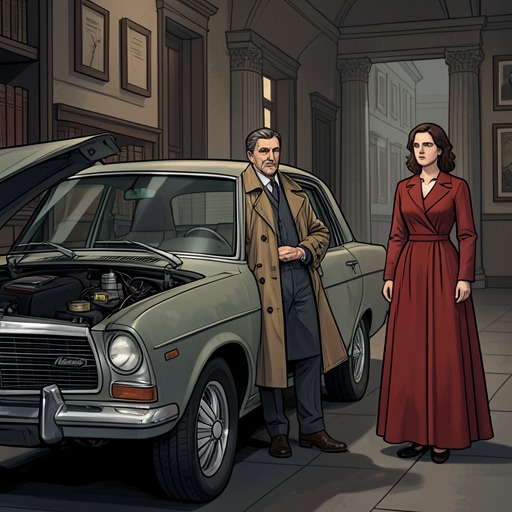
Taylor enters the relationship as a young chauffeur employed by the Sternwood household. His attachment to Carmen predates the central murders: Bernie Ohls tells Marlowe that about a year earlier Taylor had taken Carmen to Yuma, and that her sister, Vivian, brought them back. Taylor was detained under the Mann Act, but Vivian later intervened with the district attorney, saying that he had meant to marry Carmen and that Carmen did not share that intention. The account presents Taylor’s commitment as more serious than Carmen’s; her stated aim had been to have a party, not to marry him.
The family’s response did not sever their connection. Taylor was released, and the Sternwoods subsequently employed him again. His return to the household placed him in the role of chauffeur, with access to the family’s cars and daily movements, even though the earlier episode had exposed a sharp difference between his apparent intentions and Carmen’s. The relationship thus begins with a mismatch of commitment, but it persists within the unequal setting of a wealthy household and its employee.
Attachment Made Visible
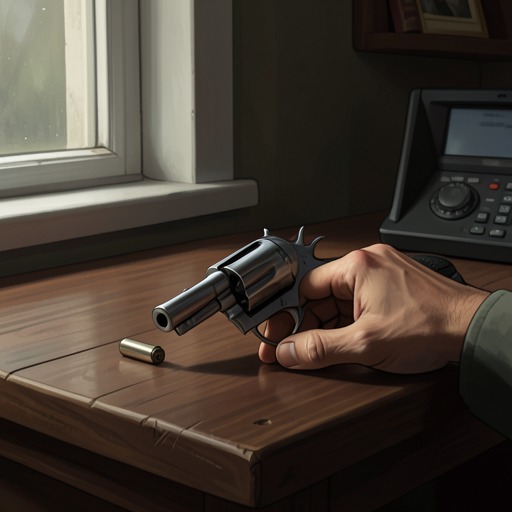
A small object offers the clearest surviving sign of Taylor’s personal connection to Carmen. Marlowe finds her .22 revolver with a pearl grip and a silver plate engraved “Carmen from Owen.” Its inscription presents the weapon as a gift from Taylor to Carmen, joining his name to hers in a private token. The gun later becomes evidence in the investigation, so an intimate object also enters the chain of violence and police scrutiny.
The inscription does not establish that Carmen returned Taylor’s feelings. Rather, it sits beside Ohls’s earlier account that Taylor intended marriage while Carmen did not. Marlowe’s description of the family chauffeur as “sweet on Carmen” likewise characterizes the attachment from the outside. The evidence therefore supports a clear distinction between Taylor’s devotion and Carmen’s less committed response, without supplying a fuller account of what either understood the relationship to be after he returned to the household.
Geiger’s Death and Taylor’s Intervention
Marlowe reconstructs the decisive episode from the evidence surrounding Geiger’s death. Taylor took one of the family cars to Geiger’s house, entered through the back with a jimmy and a gun, and found Geiger photographing Carmen without clothes. Marlowe concludes that Taylor’s gun went off and Geiger died; Taylor then fled with the negative Geiger had just made. Taylor’s actions turn his attachment into an intervention against the threat posed to Carmen, but the intervention is itself lethal and leaves a concealed trail.
Marlowe’s explanation connects motive, opportunity, and the object of the blackmail. Taylor was in a family car without permission, had access to the scene, and, in Marlowe’s judgment, had a motive rooted in jealousy and anger at Geiger’s treatment of Carmen. Marlowe argues that the nude-photograph scheme was precisely what would have driven Taylor to act. Taylor took the negative away from the scene; Joe Brody later obtained it from him. The photograph therefore links Taylor’s protective response to the blackmail that threatened Carmen and to the later struggle over evidence.
Death, Concealment, and Public Account
Taylor’s involvement becomes known through the discovery of his Buick in the water off Lido Fish Pier, with his body inside. Brody admits that he followed Taylor after Geiger’s death, struck him unconscious, and took the photographic plateholder; Taylor later regained consciousness and escaped Brody. Marlowe uses the chain of events to distinguish Taylor’s action from Brody’s commercial interest in Geiger’s operation: in his view, Taylor had both a personal motive and the opportunity to kill Geiger, whereas Brody wanted to take over the racket and obtain the photograph.
The police and newspapers do not preserve that distinction in their public version. Marlowe tells the authorities most of what happened but leaves out Carmen’s visit to Brody’s apartment and Eddie Mars’s visit to Geiger’s. The next morning’s newspapers describe Taylor as the driver of a supposed suicide car and do not connect him to the killing at Geiger’s house. Instead, they credit Captain Cronjager with a simplified account in which Brody killed Geiger and Carol Lundgren killed Brody. Taylor’s connection to Carmen, the motive Marlowe assigns him, and his removal of the negative disappear from the published story.
Narrative Significance
The relationship makes private attachment part of the machinery of the case rather than a separate romantic subplot. Taylor’s earlier attempt to take Carmen away, his return to service in her family’s household, the revolver bearing their names, and his action at Geiger’s house form a sequence in which care and danger become inseparable. The evidence identifies his feelings more clearly than Carmen’s and does not turn his intervention into a mutually shared romance: it shows a man acting for her, while the consequences are shaped by a photograph made without her consent, a killing, and a struggle to control what becomes known.
Their relationship also exposes the distance between what the investigation establishes and what the public is told. Taylor’s personal motive helps Marlowe explain Geiger’s death, yet the official narrative recasts Taylor as a despondent chauffeur whose death is unconnected to the other killings. The engraved gift remains a concise private sign of the bond; the newspaper account removes that bond from view. In that contrast, Taylor’s attachment survives as evidence, while its meaning is largely excluded from the public record.